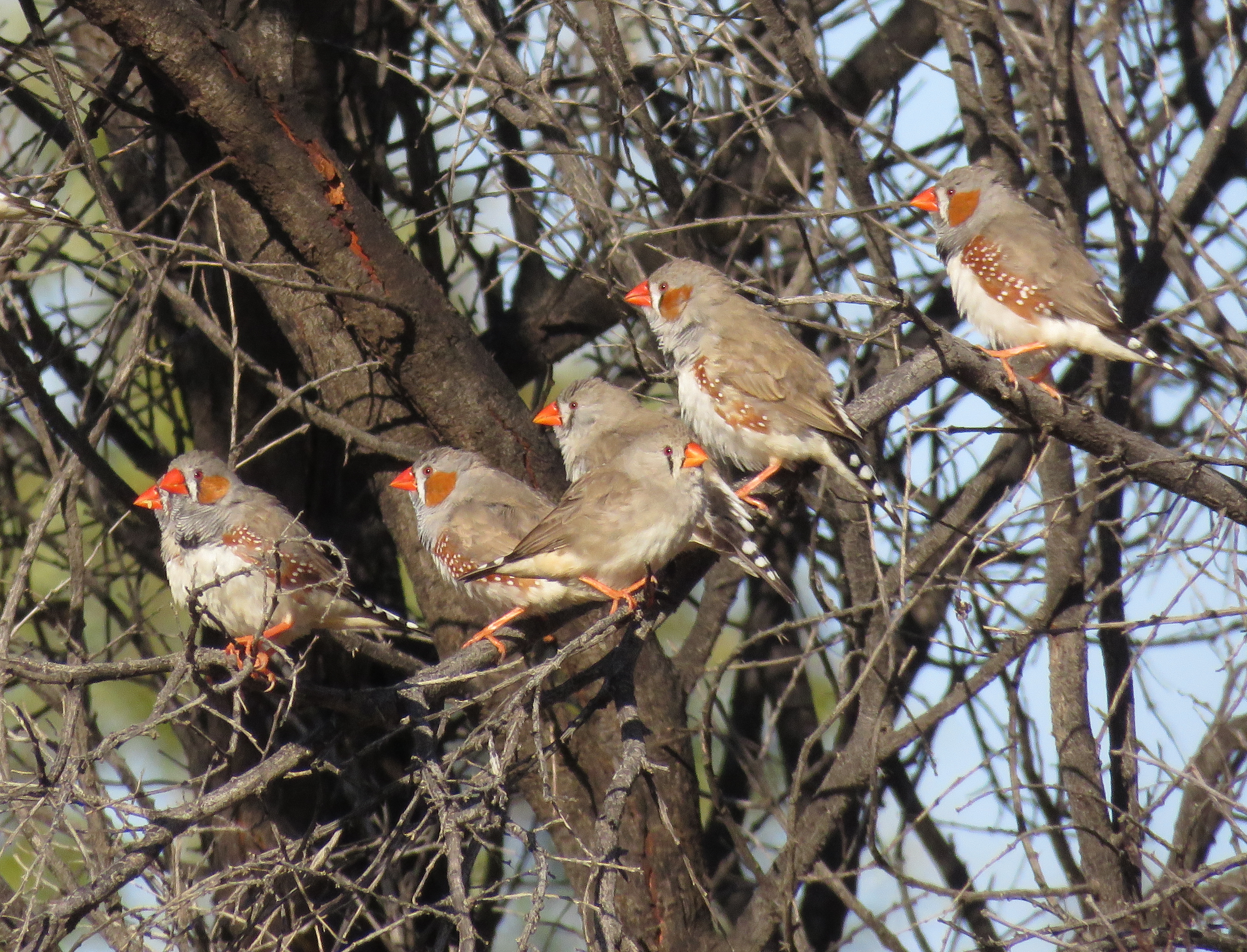
 Our attempts to understand avian behaviour usually focus on important components of life such as foraging, territorial defence, breeding and anti-predation strategies. In our study of the zebra finch, led by Hugo Loning, and a collaboration between researchers from Wageningen University (Netherlands), and Macquarie University (Australia), we focused our attention on what the birds are doing in their downtime – the bits of the day when they aren’t actively engaged in other behaviours, and are just ‘hanging out’.
 The habitat of the study site near Fowlers Gap research station is a very open grassland with small patches of acacia trees, such as those in this ephemeral creek line.
The study was conducted at Fowlers Gap Arid Zone Research Station in arid Australia where a wild population of zebra finches has been the focus of research for 19 years. We identified a number of specific trees or bushes throughout the study area that were frequented on a regular basis by groups of zebra finches. These locations, identified as ‘social hotspots’ were not obviously different from other bushes or trees in the same area, either structurally, or in their position. However, they were the focus of prolonged social gatherings over the course of the study, and anecdotally some had been in use consistently for several years. The social hotspots were identified both by the frequent presence of zebra finches in them, but also by a significant accumulation of zebra finch droppings underneath them. One of the social hotspots was found in the dead tree to the left of this picture. Social hotspots were found in both living and dead trees, and they didn’t differ in an obvious way from other trees or bushes in the local vicinity.
  Large accumulations of droppings were found underneath social hotspots, indicating their prolonged use by large numbers of birds.
In our study, we characterised social hotspots using direct observational work and longer-term acoustic monitoring. The social dynamics of the hangouts were quite complex, with birds typically arriving and departing in smaller groups, rather than all in a single group. Social gatherings could collectively last for hours at a time, even though individuals came and went, and probably few were present for the whole duration of the hangout.
There were birds present in these social hotspots for over 35% of the hours of daylight, and consequently, these specific locations provided individuals with a good opportunity to find and meet conspecifics from the local population. Although zebra finches usually moved around the local area in pairs, or small groups, the social hangouts were occupied by an average of about 30 birds, with as many as 77 birds hanging out together in a typical acacia tree about 3m wide and 3m tall. The social hotspots therefore provided lots of opportunity for social interactions with many birds from the local population, and there was typically a consistent level of vocalisations, including lots of singing, by multiple males.
Although our study was unable to follow individual movements or participation in these social gatherings, we suggest that social hotspots and hangouts such as those that we have described in the zebra finch are an important, and often neglected part of social behaviour in birds. They will provide a relatively safe refuge during the day where individuals can take advantage of safety in numbers, whilst resting, preening, and socialising with conspecifics.
Further study of such social hotspots should provide insight into their capacity to increase social networking opportunities and information exchange across the wider population. We believe that social hotspots and hangouts are a neglected feature of the behavioural ecology of many social birds and are worthy of further attention.

 Griffith Ecology Lab