Despite looking the same, no two zebra finches are ever alike, and that is because whenever an offspring is produced, the genetic material is a novel combination of that from it’s mother and father. In addition, novel mutations arise during the process of creating eggs and sperm, and that provides variation which selection can act on, leading to evolution of new species over millions of years.
In our recent study, led by Djivan Prentout (and the team at Columbia University, New York) we studied the whole genome sequences of 80 individual zebra finches from our captive population in Sydney. The birds came from three generations, i.e. offspring, their parents, and grand-parents. This allowed us to examine the number of mutations that arose as DNA was copied from one generation to the next.
Germline mutation and meiotic recombination are fundamental genetic processes that give rise to genetic diversity and fuel evolution. Most of our knowledge about these processes stems from a handful of model organisms and studies in mammals. Here, we characterized properties of mutation and recombination in the zebra finch (Taeniopygia castanotis), which, like other birds, differs from mammals in several potentially salient respects, including its karyotype and the mechanism by which recombination is directed to the genome. By sequencing the genomes of three-generation pedigrees, we identified de novo mutations and recombination events (both crossovers and non-crossovers).
We identified a total of 202 do novo mutations and 1088 cross-overs (whereby novel combinations of chromosomes were produced in offspring.
Our analysis indicates that the sex-averaged mutation rate is comparable to those of mammals with similar generation times. Several aspects of recombination resolutions are also similar to those in mammals, notably the estimated ratio of crossovers to non-crossovers. Thus, our findings indicate that many aspects of mutation and recombination remain conserved over large phylogenetic distances
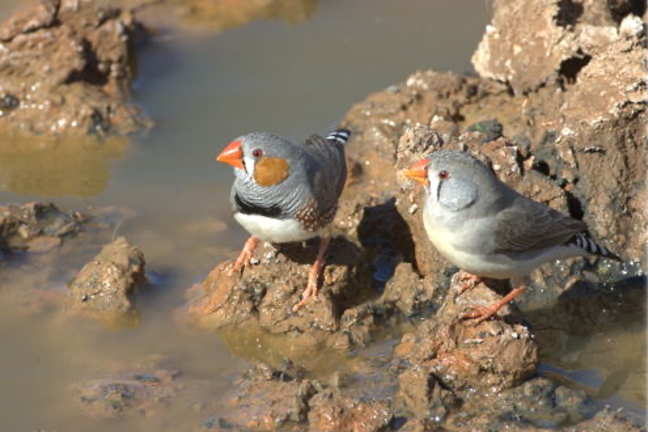
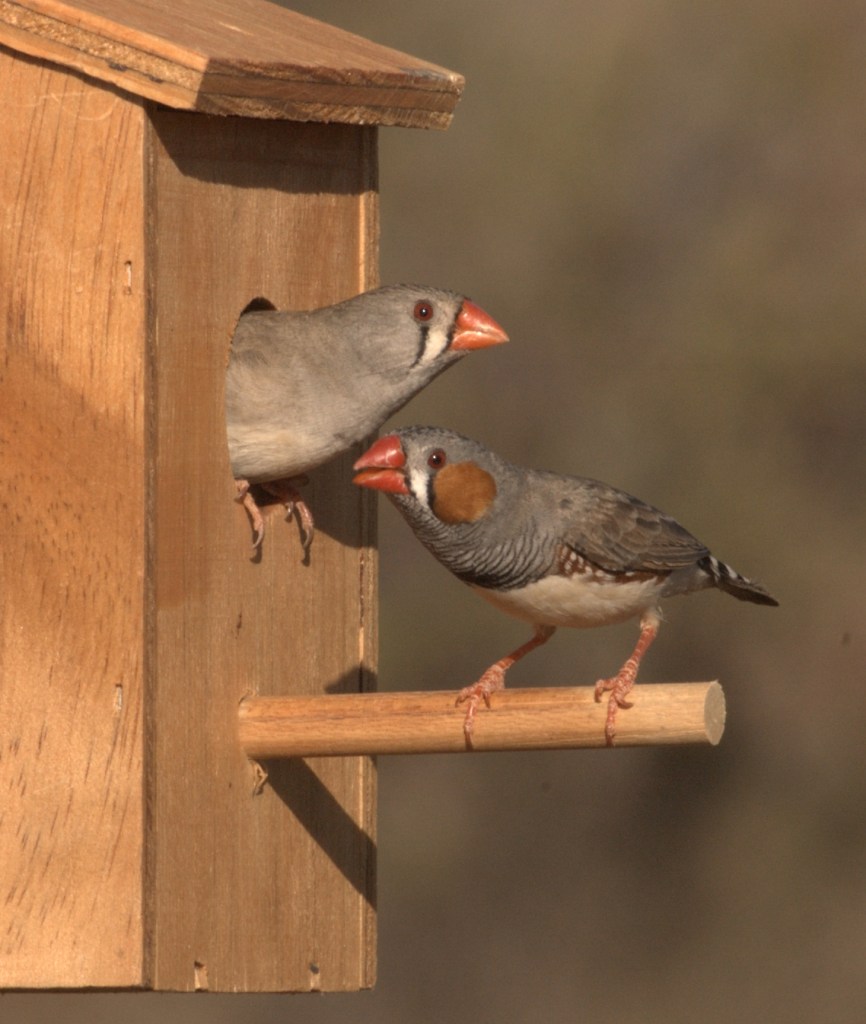
In our recent paper (here), we demonstrate just how closely a male and female zebra finch move around together. The study, which was led by Chris Tyson (Wageningen University), used small solar-powered radio-tags connected to an automated sensor array, to track the movements of individual birds as they moved around in our main study site at Gap Hills. We know that zebra finches mate with a partner for life, and that they become very behaviourally coordinated over time. However, until we used this new cutting-edge technology we didn’t know just how tightly coordinated their behaviour was. Here we revealed that the distance between partners was usually about 50m, and in reality they were probably closer, because the technology was only able to localise a bird to within about 35m with great accuracy. As illustrated in the photos above, our tracking of the 32 individuals in 16 different pairs, indicated that as the birds moved around throughout the day to water, their nest, and whilst foraging, they did so very closely with their partner. This new study contributes towards our growing collection of studies that have characterised the quality and closeness of the pair-bond in the zebra finch. The pair-bond is particularly tight in this species, and probably helps them to survive and reproduce effectively in the harsh arid zone of Australia in which they live.
In our recent paper, led by Madeleine Wheeler, we continue our examination of the effects of extreme heat on zebra finches. We have previously found that when young are raised in hot temperatures they end up being smaller as adults, and this could be explained either the direct effect of hot weather on their physiology, or perhaps on the ability of their parents to provision them with food during such hot conditions. Here we analysed nest visitation rates over a range of temperatures and demonstrated that, indeed, when temperatures became extremely hot, parents reduced the rate at which they visited nestlings. This result is consistent with our earlier findings that adults are unable to forage in such conditions (Funghi et al 2019) and that desert birds generally avoid breeding in the hottest times of the year (Englert Duursma et al 2017, 2019). The paper can be found here.
It’s very exciting to see the publication today in Current Biology of our paper that describes the genomic basis of the bill colour variation in the two sub-species of the long-tailed finch. This is one of the key questions that I have been working towards with Daniel Hooper since 2015. Since our first field trip together to the Top End of Australia, Daniel has examined the genome sequence of over 1,200 individuals from across the wild range of the birds, and captive bred hybrids in the laboratory (many of which were sampled and bred by Callum McDiarmid). The cutting edge genomics has been completed with input from Peter Andolfatto, Frank Chan and Marek Kucka; the biochemistry of the carotenoids underlying the yellow and red bills was unravelled by Geoff Hill, Matthew Powers, and Nicholas Justin; and finally the work examining the fine anatomy of the retina was done by Nathan Hart, who demonstrated that even though the yellow-billed birds don’t make red carotenoids to put in their bills, they do still make them to use in the oil droplets that are used to filter light in the retina. It’s been super cool to work with all these amazing people to complete this huge study. The scale of the work can be seen in Fig 1 from the paper below that shows the sites that were sampled in the wild (E) and the variation in colour across them (F) and the lab-bred hybrids (D). The full paper can be found here
It’s very exciting to report that Lyanne Brouwer and her team have just tagged the first southern black-throated finch up in Townsville. This endangered bird has declined across over 90% of its range in the past half century and there are only two areas in which they can be regularly found. One of these is the study site on the outskirts of Townsville.
To better manage and preserve these beautiful birds we do need to understand their habitat requirements, behaviour and movement ecology. In our project we are aiming to track birds intensively as they move around to gain important insights into these areas.
A number of birds will be fitted with these very small and lightweight radio tags. The signals will be picked up by a number of radio nodes, which will allow us to understand how much they are moving on a daily level and which areas of the local habitat they are utilising most.
The field team, led by Prof. Lyanne Brouwer, with Tis Voorstman and Parvaiz Yousef.
About a decade ago it was first proposed that the tight interaction between the nuclear genes, and the mitochondrial genes might play an important role in the process of speciation, contributing to patterns of geneflow across closely related species where they are in contact with each other. We were inspired to work in this area by Paul Sunnocks’ work on the eastern yellow robin, and Geoff Hill‘s excellent book ‘Mitonuclear Ecology.
Our first major paper testing these ideas has just been published in Molecular Ecology, and was part of Callum McDiarmid’s PhD thesis work (link to paper).
Our study was built on an amazing pre-existing knowledge of the highly conserved nuclear and mitochondrial genes that are largely shared across eukaryotes, and help to drive the operation of the mitochondria in cells, that produce most of the cellular energy. In birds 37 genes in the mitochondrial DNA (mtDNA) work closely with around 1,500 nuclear genes. This prior knowledge allowed us to characterise the differences between the two subspecies of long-tailed finch that we have been working on in the wild and laboratory for many years. The yellow-billed (acuticauda) and red-billed (hecki) subspecies last shared a common ancestor around 0.5 million years ago.
Poephila acuticauda acuticauda (the yellow-billed form from the western part of northern Australia) and Poephila acuticauda hecki (the red-billed form from the eastern part of northern Australia). (Photo Simon Griffith)
Due to the well-worked genetics of mitochondrial respiration in birds and other organisms, and the genomic sequencing that Daniel Hooper has been leading in the long-tailed finch as part of our collaboration, we were able to ascertain that there were fixed differences in just 0.9% of the sequence of the protein-coding genes between the two sub-species. There were also fixed differences in non-coding regions, that could effect the transcription, translation, or replication of mtDNA.
Figure 3 from McDiarmid et al (2024) – illustrating the evolutionary divergence for the 13 protein-coding mitochondrial genes indicating that just
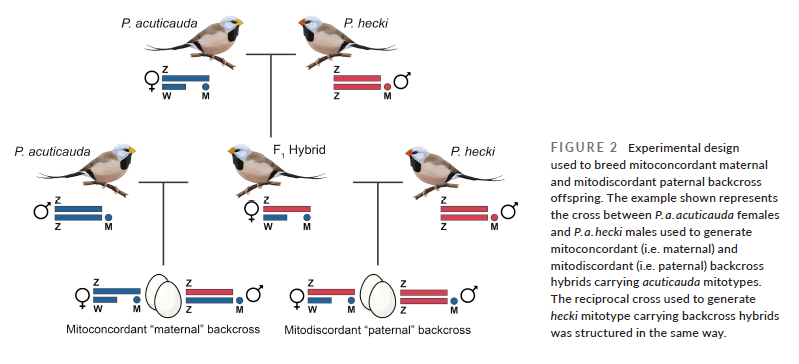
An organisms mitochondrial DNA is inherited only from it’s mother, and this allowed us to generate experimental offspring in the laboratory in which the mtDNA was in the wrong nuclear genetic background. This was done by first breeding F1 hybrid offspring – produced with either a yellow mother and red father, or vice versa. In these F1 hybrids, the mtDNA matches the sex chromosome (ZZ in males and ZW in females) that was inherited along with the mitochondria from the mother. Crucially however, when we backcross female hybrid offspring to a parental type male (paternal backcross) the mitochondrial DNA end up in the ‘wrong’ genetic background.
Figure 2 from McDiarmid et al 2024 – Explaining the laboratory cross design that allowed us to place the mitochondria in the ‘wrong’ nuclear genetic background.
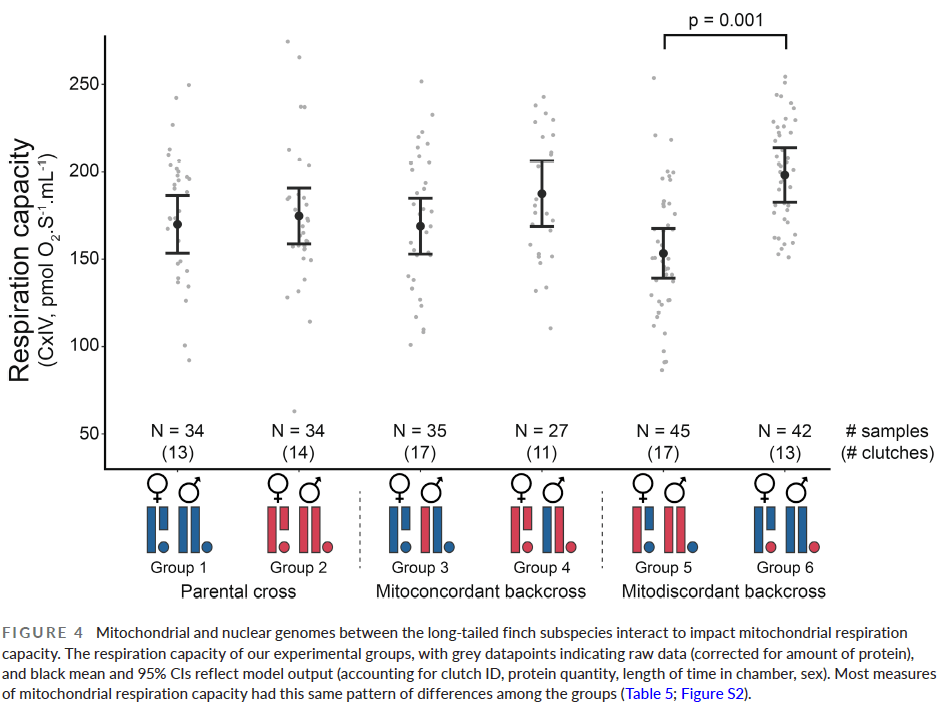
Using this experimental design we tested for functional effects of mitodiscordance (i.e. when mitochondrial DNA does not perfectly match nuclear DNA), using an Oroboros oxygraph machine to measure cellular respiration in cells from the different crosses. This machine can effectively measure the respiration capacity – the ability of an organism to make the cellular energy that fuels all growth, movement and cellular activity.
Our key findings were that we found a significant difference in the respiration capacity (the ability of an organism to make the cellular energy that fuels all growth, movement and cellular activity) of the two different types of mitodiscordant crosses, but not between those and other types of cross, like those between pure parental types (see the difference between Group 5 and 6 below).
The difference between these two mitodiscordant backcrosses that we have demonstrated using a careful experiment in the laboratory is entirely consistent with the pattern of admixture in the wild. Group 5 here are individuals with acuticauda mtDNA in an otherwise hecki genome, while Group 6 individuals have hecki mtDNA in an acuticauda genome. The acuticauda mitotype therefore performs relatively poorly in the wrong background, compared to the hecki mitotype. The two subspecies are in contact in the wild, and we have found that 83% of those individuals that have mismatched mtDNA and nuclear genome in the wild have the hecki mitotype (i.e. as we have shown experimentally, that mitotype performs better when in the wrong background). Secondly, in the wild the contact zone between the subspecies is slightly complicated with the cline of mtDNA displaced about 55km to the west of the nuclear DNA cline. i.e. the hecki mtDNA is able to move further westwards, presumably because it performs better than the acuticauda mitotype in the zone of mixed genomes.
Figure 1b from McDiarmid et al (2024). This clinal analysis illustrates that the mtDNA cline is displaced further to the west than the nuclear DNA cline. i.e. the eastern mitotype (hecki) does better in a western acuticauda genomic background than vice versa.
In summary, whilst there is a relatively low level divergence between the mitochondrial DNA of the two subspecies that we have been studying in northern Australia, using experimental crosses in the laboratory, coupled with a sophisticated method for measuring the efficiency of cellular respiration, we have been able to show how functional differences can effect the introgression of genes from one from into another when species come together in secondary contact. Our findings from a bird add to recent work on other animals that support the idea that interactions between the mitochondrial and nuclear genomes can play important roles in the speciation process.
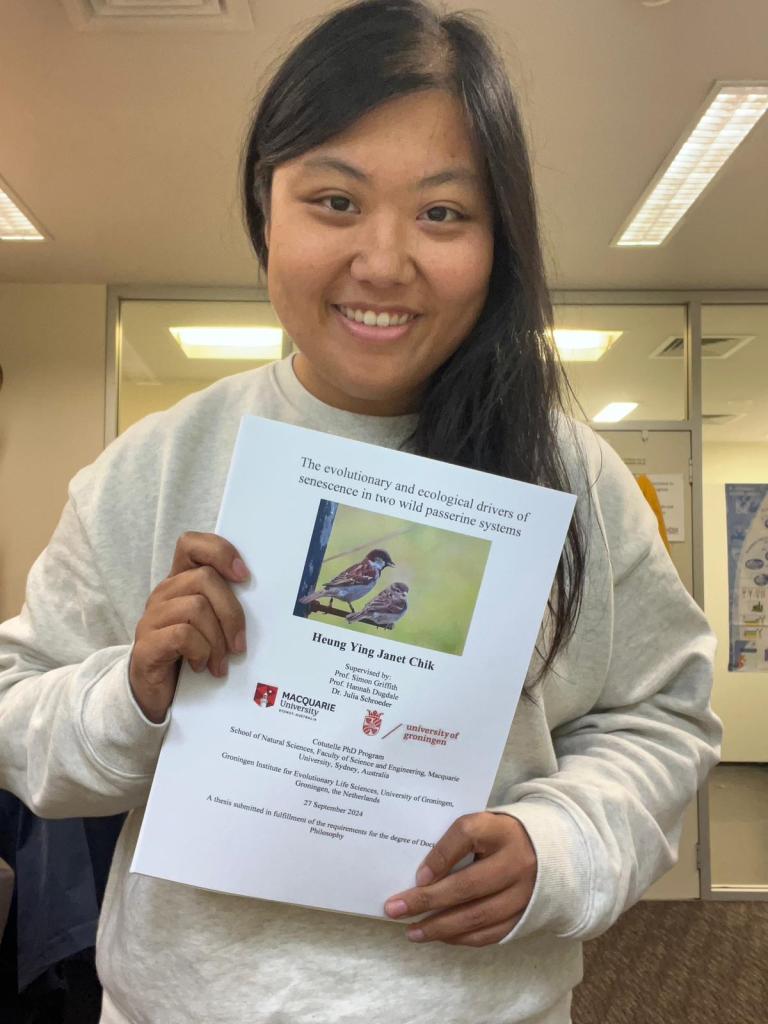
Congratulations to Janet Chik who today submitted her thesis, entitled “The evolutionary and ecological drivers of senescence in two wild passerine systems”.
Janet completed a joint PhD between the University of Groningen (Netherlands) and Macquarie University. In Europe Janet was supervised by Prof. Hannah Dugdale and Dr. Julia Schroeder and by myself in Australia. Janet worked on the best study species – the house sparrow Passer domesticus. Janet’s research was on telomeres in the context of the long-term population of sparrows on Lundy Island, and the context of lead (Pb) contamination in Broken Hill Australia.
Janet is the most recent in a long line of students to have focused their PhD research on the sparrows of Lundy Island, including myself back in the mid-nineties.
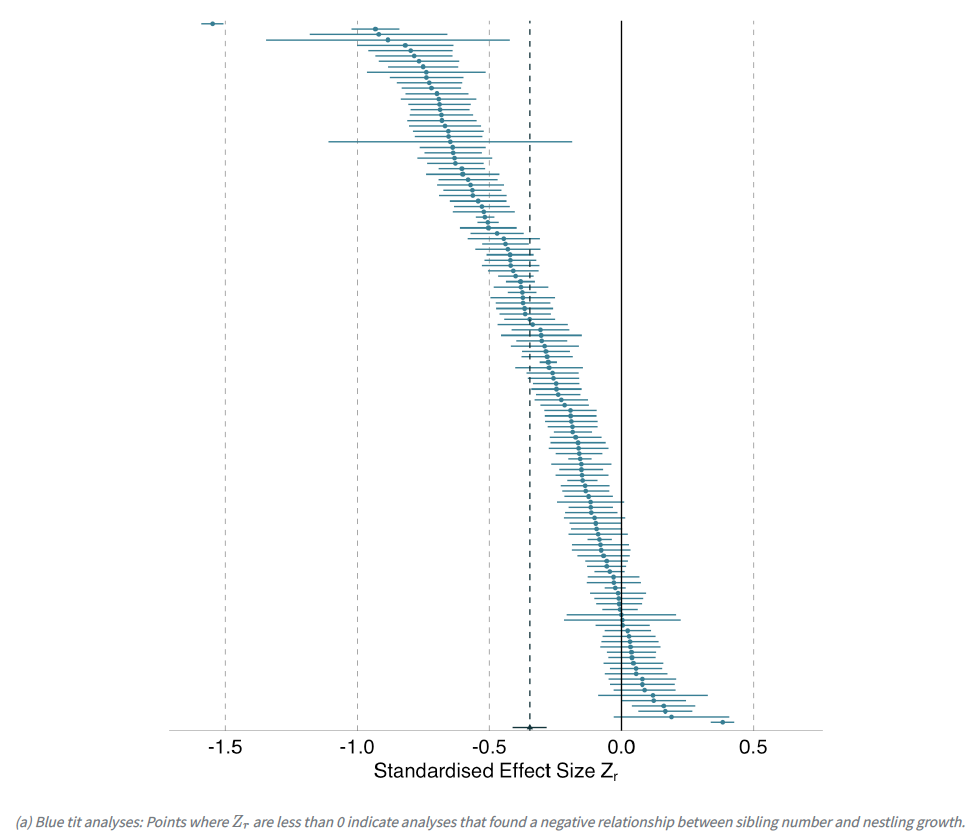
After twenty years of procrastination one of our bluest datasets has finally been analysed! The data was one of two sets of data used in a ‘many analysts’ study to look at how the choices that are made in an analysis pathway affects outcomes. The study is covered in a news story published today in Nature.
The dataset was one of two that were analysed by 246 biologists in the study which is available online. The variation in the outcomes was remarkable given that all analysts started with the same dataset and were addressing the same question – how is nestling growth affected by the number of siblings that offspring have in the nest. There is continuous variation in the effect that analysts found. A number of analyses found significant positive effects, many found no effect and the majority found significant negative effects of siblings on growth. The study is revealing about the robustness of results in ecology and should hopefully help lead to a different approach to analyses in the future.
Frigg Speelman recently won the Macquarie University 3MT competition. The challenge of this competition is to deliver a three minute verbal presentation summarising the focus of her thesis. Frigg’s success was covered by a nice article in the Macquarie Newsletter here.
Frigg missed the award ceremony as she was in the field, catching chirupping wedgebills
In a paper published today in Current Biology, we have characterised the very social nature of song in the zebra finch, and this helps to highlight the fact that bird song is not always about competition over mates and territories. In the study, led by Hugo Loning, a student in Marc Naguib’s research group in Wageningen University (Netherlands), we have analysed the expression of song over several years and in a variety of contexts. The study is an amalgamation of data collected by remote acoustic recorders every three days at Fowlers Gap for several years, across a lengthy drought, and periods of breeding and no breeding activity. The main finding are that zebra finches sing a lot regardless of the season, or condition of the local environment. Males usually sing in the presence of their female partner (who they are typically paired with for life), and also in close company with other males. We believe that our findings should place a greater emphasis on the social function of birdsong more generally, and that it is a useful signal for the coordination of activity across a population of birds. Our findings are in contrast with the great majority of studies of bird song that emphasise the competitive nature of bird song.
There is a piece written about the work in Macquarie’s Lighthouse magazine which includes some video of singing males.
Tito’s first paper was published today in Conservation Physiology. The paper, which includes some of Tito’s data, is a response to a recent model that had evaluated the likely effects of climate change on some of Australia’s birds. In our response, we used data from our study of the zebra finch to argue that the assumptions that are commonly made about the effects of a warming climate on birds are often over simplistic and aren’t able to account adequately for the adaptive responses that birds are likely to make. For example, in the paper we show that one of the important responses that birds will make on extremely hot days is to drink significantly more water than normal. If birds can stay adequately hydrated they are able to use that water to reduce their body temperature significantly and guard against hyperthermia. We also argue that there is an urgent need to get better physiological data from the zebra finch and other species to improve the value of predictive models in the future. The climate is changing and more extremely hot days are likely. That does cause a significant challenge for birds and there will be a tipping point for survival at some temperature. That point is likely to be slightly higher than the one predicted by earlier models though given the remarkable adaptive responses that we have demonstrated in the zebra finch. The full paper can be found here.
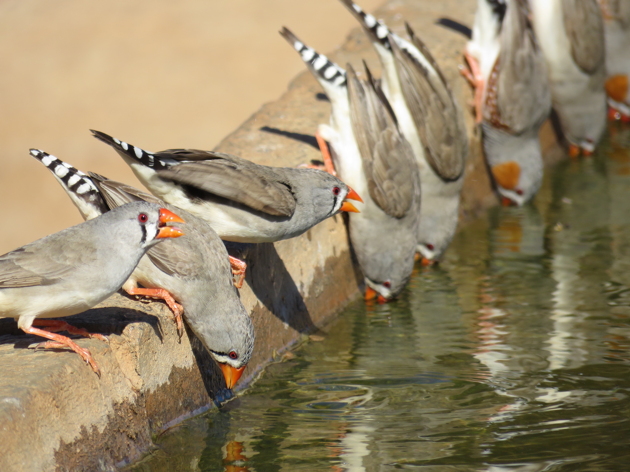
When it gets hot zebra finches drink more, and make use of the many artificial water points across the arid landscape such as this stock watering trough. (photo: Simon Griffith)
The physiological effects of high blood lead levels in the House sparrow
Congratulations to Tiarne Harris who submitted her MRes thesis today. Well done on all the amazing work you have put in over the past 12 months. I’m really excited about the results that you have found in the Broken Hill sparrows and the future research directions that they have stimulated.
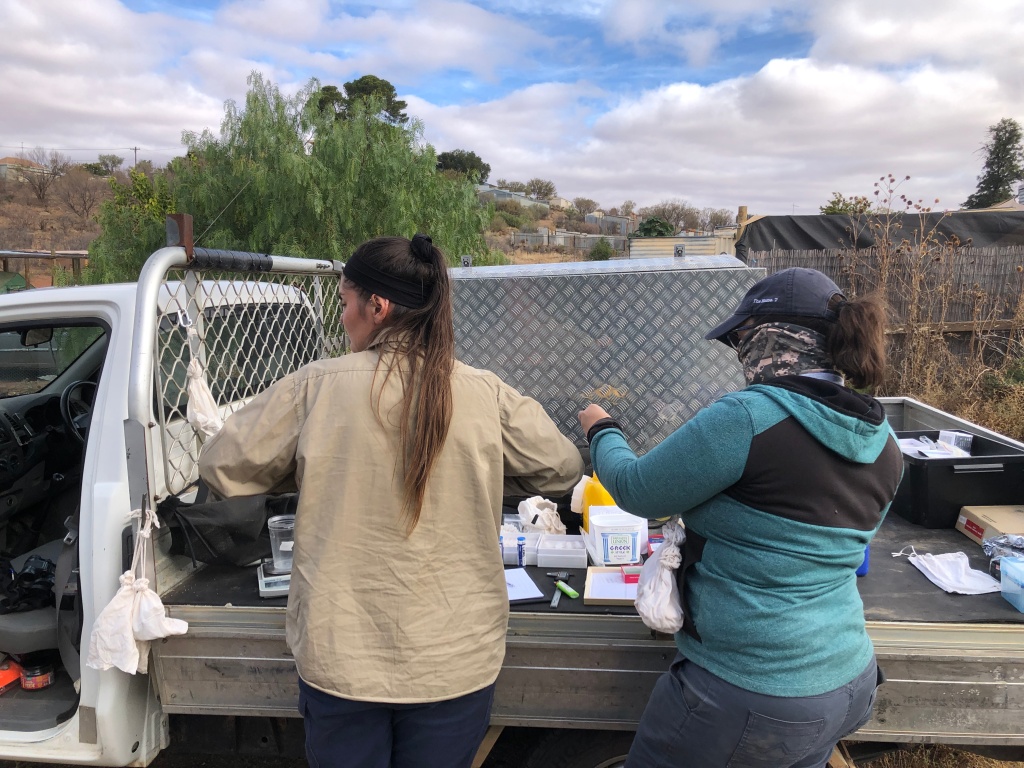
Tiarne (left) and Lori out at Lex’s in South Broken Hill collecting some of her data.






 Griffith Ecology Lab