THE UNEXPLORED BENEFITS OF JUST HANGING OUT IN A SOCIAL HOTSPOT

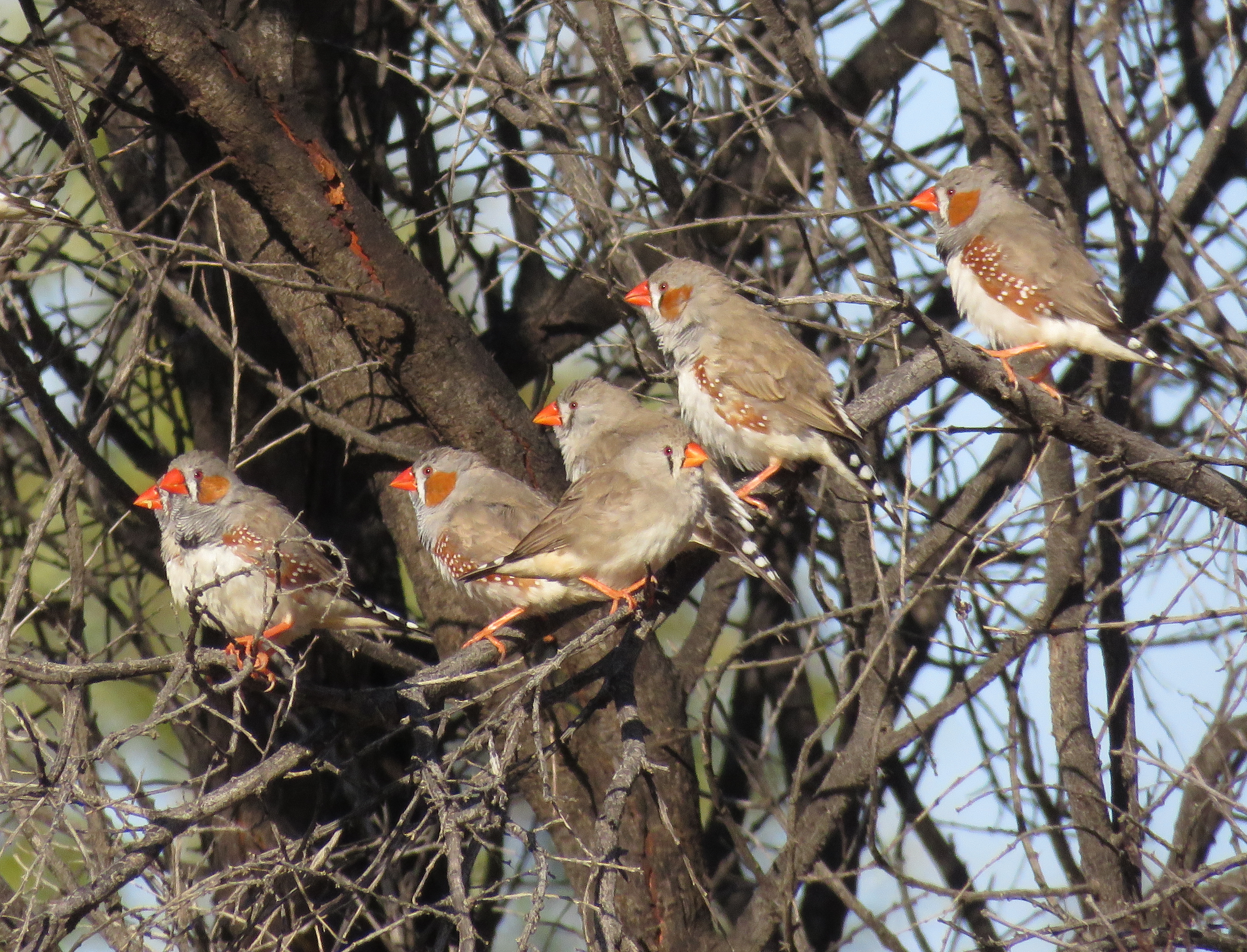
Our attempts to understand avian behaviour usually focus on important components of life such as foraging, territorial defence, breeding and anti-predation strategies. In our study of the zebra finch, led by Hugo Loning, and a collaboration between researchers from Wageningen University (Netherlands), and Macquarie University (Australia), we focused our attention on what the birds are doing in their downtime – the bits of the day when they aren’t actively engaged in other behaviours, and are just ‘hanging out’.​ The habitat of the study site near Fowlers Gap research station is a very open grassland with small patches of acacia trees, such as those in this ephemeral creek line.

The study was conducted at Fowlers Gap Arid Zone Research Station in arid Australia where a wild population of zebra finches has been the focus of research for 19 years. We identified a number of specific trees or bushes throughout the study area that were frequented on a regular basis by groups of zebra finches. These locations, identified as ‘social hotspots’ were not obviously different from other bushes or trees in the same area, either structurally, or in their position. However, they were the focus of prolonged social gatherings over the course of the study, and anecdotally some had been in use consistently for several years. The social hotspots were identified both by the frequent presence of zebra finches in them, but also by a significant accumulation of zebra finch droppings underneath them. One of the social hotspots was found in the dead tree to the left of this picture. Social hotspots were found in both living and dead trees, and they didn’t differ in an obvious way from other trees or bushes in the local vicinity. Large accumulations of droppings were found underneath social hotspots, indicating their prolonged use by large numbers of birds.

In our study, we characterised social hotspots using direct observational work and longer-term acoustic monitoring. The social dynamics of the hangouts were quite complex, with birds typically arriving and departing in smaller groups, rather than all in a single group. Social gatherings could collectively last for hours at a time, even though individuals came and went, and probably few were present for the whole duration of the hangout.

There were birds present in these social hotspots for over 35% of the hours of daylight, and consequently, these specific locations provided individuals with a good opportunity to find and meet conspecifics from the local population. Although zebra finches usually moved around the local area in pairs, or small groups, the social hangouts were occupied by an average of about 30 birds, with as many as 77 birds hanging out together in a typical acacia tree about 3m wide and 3m tall. The social hotspots therefore provided lots of opportunity for social interactions with many birds from the local population, and there was typically a consistent level of vocalisations, including lots of singing, by multiple males.

Although our study was unable to follow individual movements or participation in these social gatherings, we suggest that social hotspots and hangouts such as those that we have described in the zebra finch are an important, and often neglected part of social behaviour in birds. They will provide a relatively safe refuge during the day where individuals can take advantage of safety in numbers, whilst resting, preening, and socialising with conspecifics.

Further study of such social hotspots should provide insight into their capacity to increase social networking opportunities and information exchange across the wider population. We believe that social hotspots and hangouts are a neglected feature of the behavioural ecology of many social birds and are worthy of further attention.

Egg-shape and climate

Daisy’s second published paper from her PhD research is published today in Scientific Reports and is Open Access and can be downloaded here.

The media release for this story is below and explains the main findings and their implications.

EggShape
All of these species lay their eggs in open-cupped nests. The three species at the top breed in moist habitats, whereas the three at the bottom breed in the dry and hot desert regions, and their eggs are noticeably rounder.

New scientific study examines why eggs are shaped as they are

  • The shape of a species’ egg is determined by the climate in which they typically breed, and the extent to which their nest protects the egg from the sun.
  • The classically-shaped eggs with which we are so familiar have a greater surface area to volume ratio than a spherical egg, allowing for a greater level of gas exchange between the embryo and the environment.
  • As Easter approaches and the shops are full of chocolate eggs, it is a good time to be wondering why bird eggs are egg shaped and not nice round balls.

A new study published today in Scientific Reports by scientists from Macquarie University helps us understand why the classic egg shape evolved in birds and explains some of the species variation in egg shape.

The study examined egg shape in over 300 species of Australian birds, that live across some of the most extreme climates on earth, from the wet and humid tropics, to the dry and hot inland deserts.

The study found that the shape of a species’ egg is determined by the climate in which they typically breed, and the extent to which their nest protects the egg from the sun.

The most spherical eggs were typically found in desert species nesting in open nests, where the embryo inside the egg is likely to be damaged by the heat from the sun and dehydration. The most elongated or ‘egg-shaped’ eggs were found in moist environments, or in species that have enclosed nests, which are not exposed to the elements.

Lead author Daisy Duursma from the Department of Biological Sciences said as Easter approaches and the shops are full of chocolate eggs, it is a good time to be wondering why bird eggs are egg shaped and not nice round balls.

“There is a tension between allowing oxygen to get inside the egg so the embryo can breathe, but at the same time not allow too much moisture to escape and risk dehydration”.

The classically-shaped eggs with which we are so familiar have a greater surface area to volume ratio than a spherical egg, allowing for a greater level of gas exchange between the embryo and the environment.

The classic egg-shaped eggs are laid in relatively protected environments and prioritise gas exchange for the developing embryo to breathe, in a context where dehydration is less of a concern. The opposite is true in harsh environments where eggs are exposed to the elements.

“The egg shape is an adaptation that balances the need for the embryo to breathe without losing too much water, and can be nicely seen by looking at the eggs that are laid by different species across the diverse continent of Australia,” concluded Professor Simon Griffith, the leader of the project.

Readiness to breed is related to condition and stress across populations of zebra finch in the Northern Territory

OndiMap
The location of the five populations studied across the Northern Territory

Well done to Ondi Crino (now at Deakin University), who today saw her paper published, focused on probably the most remote field sites that we’ve worked on to date. Ondi measured the condition of birds across these five different sites, which all faced different ecological conditions, likely due to the different rainfall that they had experienced over the couple of years prior to the sampling. Birds in the different locations were in different condition and their stress hormones reflected this. Both things were correlated with the amount of breeding activity that we found across these five populations. The study is a step towards understanding the mechanisms underlying the opportunistic breeding that is seen in so many Australian birds – where birds will only breed when the local conditions are good. The paper was published today in General and Comparative Endocrinology and can be found here.

Sheep Project underway

sheepmontage
Social sheep at Fowlers Gap, NSW

Our new sheep research project is now underway, with the first trip by Dr Stephan Leu to Fowlers Gap, to trial the new tracking collars and start planning the first experiments! Stephan’s project will investigate movement, foraging efficiency, life history and the benefits of social behaviour in rangeland sheep.


Four PhD positions in our research group

We have four quite different PhD projects in the research group that have been advertised today. These are working across four species and some similar research questions. Three of the projects are based at Fowlers Gap which is an amazing field site in the arid zone near Broken Hill, where we have worked for the past 13 years. Work on the zebra finch in the wild, continues our ongoing into this species, where we have been the only lab in recent years trying to understand the ecology of the species in the wild (more details on that research here). The project with Stephan Leu is a new direction for us, into the behaviour and ecology of sheep in the rangeland. This project will use techniques that we have previously used in both birds and lizards, but use them in an applied context.

montage2

The project on the sleepy lizard is in collaboration with Martin Whiting’s group, also at Macquarie University.   We are hoping to recruit students onto all of these projects in 2017, in order to maximise the outcomes from current Australian Research Council funding to Griffith and Leu. Due to this funding the projects are well supported and will provide great research opportunities. We have a good history in the group of graduating our PhD students with a good number of peer-reviewed papers and a range of different skills that will enhance further career opportunities.

 Further Details

1: Adapting to a foreign climate: the reproductive ecology of the house sparrow in Australia

The house sparrow (Passer domesticus) was introduced into Australia in the 1860’s and has since become well established across a broad range of climates in both countries. This project will take advantage of this ‘experimental’ introduction to focus on behavioural and physiological adaptations to different climates through a field-based comparative approach. This research will complement our existing work on related questions in endemic Australian species and will provide insight into the capacity of avian species to adapt to changing climates. This project will involve periods of field-work in Broken Hill, Armidale and Hobart in Australia, along with a range of behavioural, molecular and physiological assays. The project will involve collaboration with other groups in Australia and the US.

 2: The challenge of growing in a hot climate (in the zebra finch)

In recent years we have characterised the very hot conditions in which zebra finches are raised (with nests often reaching temperatures over 40 degrees Celsius, as well as identifying adverse effects of these conditions on embryonic development, offspring growth, and adult sperm. This project is supported by an ARC funded project and will investigate the adaptations that this iconic and well-studied species has to deal with the extreme climate in which it lives. The project will take a variety of approaches including behavioural work, and assays of metabolism and physiology, and combine fieldwork and laboratory work. The project will be run in collaboration with Dr Christine Cooper (Curtin University, Western Australia), Prof. Pierre Deviche (Arizona State University, US), and Prof. Pat Monaghan (Glasgow, UK).

 3: Social structuring and life-history in free-ranging domestic sheep

In this project we will examine the importance of social structure and collective intelligence to life-history trade-offs and productivity in domestic sheep in the rangelands of Australia. The project will use tools from social network theory and spatial ecology to characterise individual and group behaviour and investigate their effect on individual quality and productivity (lambs and wool) in this challenging, but economically important part of Australia. The project will be based at Fowlers Gap (near Broken Hill in the arid zone) and require field work and well-developed analytical skills. This work will be run in collaboration with partners in the pastoral industry and be jointly supervised by Dr Stephan Leu (also at Macquarie University).

4: Parasite transmission dynamics in an Australian lizard

This project will investigate the relationship between host spatial and social behaviour and bacterial transmission. It combines social network theory, spatial ecology and wildlife epidemiology to determine how different bacterial strains are transmitted through the population and how individual behaviour and consequently population social structure changes as a function of infection status. The project combines the analysis of a very comprehensive (already collected) dataset with scope for the student to develop his/her own ideas and conduct fieldwork. The student should be interested in social networks and disease modelling and have strong analytical skills. This project will be jointly supervised by Dr Stephan Leu and A/Prof Martin Whiting (both at Macquarie University). We also have strong relationships with disease modelling colleagues in the US.

Application

The Department of Biological Sciences at Macquarie University is a vibrant environment which offers excellent support to postgraduate students. A Macquarie University Excellence in Research Scholarship has already been assigned to one of these projects, but there are other scholarship opportunities available to suitably competitive candidates. International candidates are welcome to apply for any of the projects listed above.

The 2014 MQRES full-time stipend rate is $26,682 pa tax exempt for 3 years (indexed annually). In addition to external grant support for projects, there is additional internal funding (up to $17,000) available to cover direct research expenses and conference travel.

Applicants should ideally have a research-based MSc in a related discipline (with a minimum 50% research component), and additional relevant research experience, qualifications, and details of awards or prizes. For projects 1, 2, and 4 an ability to work in remote and harsh conditions as well as experience in capturing and handling animals is desirable. A driving licence is required for all projects.

Applications should include 1) your CV, 2) a brief statement of your reasons for applying (max. 500 words) and the project you are applying to work on, 3) contact details of two academic referees, 4) your nationality (for scholarship eligibility purposes). Applications should be submitted electronically as a single PDF file.

Applications for these positions (and any initial enquiries) should be emailed by 7th April 2017 to: simon.griffith@mq.edu.au

Prof. Simon Griffith, Dept. of Biological Sciences, Macquarie University, Sydney, NSW 2109, Australia

PDF of advert

Drone workshop at Fowlers

img_2460
A UAV working at Gap Hills, one of our long-term study sites at Fowlers Gap

UAV’s or drones are increasingly being used in environmental science, as a great way of gathering imagery and deploying sensors. In mid September, Richard Lucas, from UNSW organised a fantastic meeting, which brought together a range of different UAV’s and sensors for a few days of frenetic data gathering. We were lucky enough to get involved, and helped to set up ‘challenges’ and ground truth some of the data acquired. The data that has now been gathered in Lake Paddock (the central area for the chestnut-crowned babbler project), and Gap Hill (the key area for our work on zebra finches), will provide excellent insight into the link between landscape, vegetation and avian ecology, once it is all processed and analysed.

Rain at Fowlers……

Fowlers Gap Arid Zone Research Station, where we conduct a lot of our ongoing fieldwork, has received 32mm of rain in a rain event over 7-8th May. This is a significant amount and will help to replenish the environment out there and set up a good winter and hopefully good breeding conditions for the zebra finches and chestnut-crowned babblers………