Mitonuclear interactions and speciation

About a decade ago it was first proposed that the tight interaction between the nuclear genes, and the mitochondrial genes might play an important role in the process of speciation, contributing to patterns of geneflow across closely related species where they are in contact with each other. We were inspired to work in this area by Paul Sunnocks’ work on the eastern yellow robin, and Geoff Hill‘s excellent book ‘Mitonuclear Ecology.

Our first major paper testing these ideas has just been published in Molecular Ecology, and was part of Callum McDiarmid’s PhD thesis work (link to paper).

Our study was built on an amazing pre-existing knowledge of the highly conserved nuclear and mitochondrial genes that are largely shared across eukaryotes, and help to drive the operation of the mitochondria in cells, that produce most of the cellular energy. In birds 37 genes in the mitochondrial DNA (mtDNA) work closely with around 1,500 nuclear genes. This prior knowledge allowed us to characterise the differences between the two subspecies of long-tailed finch that we have been working on in the wild and laboratory for many years. The yellow-billed (acuticauda) and red-billed (hecki) subspecies last shared a common ancestor around 0.5 million years ago.

Poephila acuticauda acuticauda (the yellow-billed form from the western part of northern Australia) and Poephila acuticauda hecki (the red-billed form from the eastern part of northern Australia). (Photo Simon Griffith)

Due to the well-worked genetics of mitochondrial respiration in birds and other organisms, and the genomic sequencing that Daniel Hooper has been leading in the long-tailed finch as part of our collaboration, we were able to ascertain that there were fixed differences in just 0.9% of the sequence of the protein-coding genes between the two sub-species. There were also fixed differences in non-coding regions, that could effect the transcription, translation, or replication of mtDNA.

Figure 3 from McDiarmid et al (2024) – illustrating the evolutionary divergence for the 13 protein-coding mitochondrial genes indicating that just

An organisms mitochondrial DNA is inherited only from it’s mother, and this allowed us to generate experimental offspring in the laboratory in which the mtDNA was in the wrong nuclear genetic background. This was done by first breeding F1 hybrid offspring – produced with either a yellow mother and red father, or vice versa. In these F1 hybrids, the mtDNA matches the sex chromosome (ZZ in males and ZW in females) that was inherited along with the mitochondria from the mother. Crucially however, when we backcross female hybrid offspring to a parental type male (paternal backcross) the mitochondrial DNA end up in the ‘wrong’ genetic background.
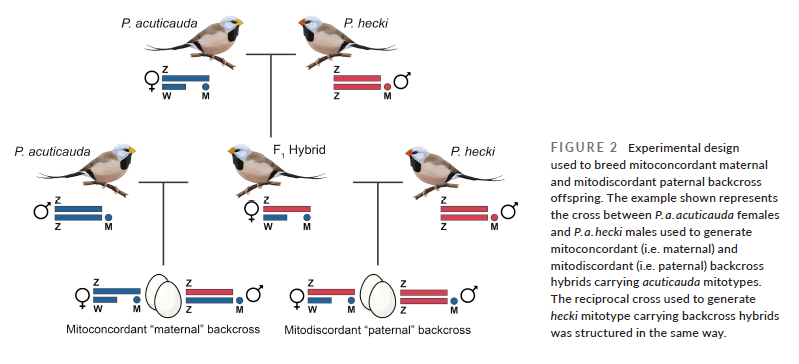
Figure 2 from McDiarmid et al 2024 – Explaining the laboratory cross design that allowed us to place the mitochondria in the ‘wrong’ nuclear genetic background.

Using this experimental design we tested for functional effects of mitodiscordance (i.e. when mitochondrial DNA does not perfectly match nuclear DNA), using an Oroboros oxygraph machine to measure cellular respiration in cells from the different crosses. This machine can effectively measure the respiration capacity – the ability of an organism to make the cellular energy that fuels all growth, movement and cellular activity.

Our key findings were that we found a significant difference in the respiration capacity (the ability of an organism to make the cellular energy that fuels all growth, movement and cellular activity) of the two different types of mitodiscordant crosses, but not between those and other types of cross, like those between pure parental types (see the difference between Group 5 and 6 below).
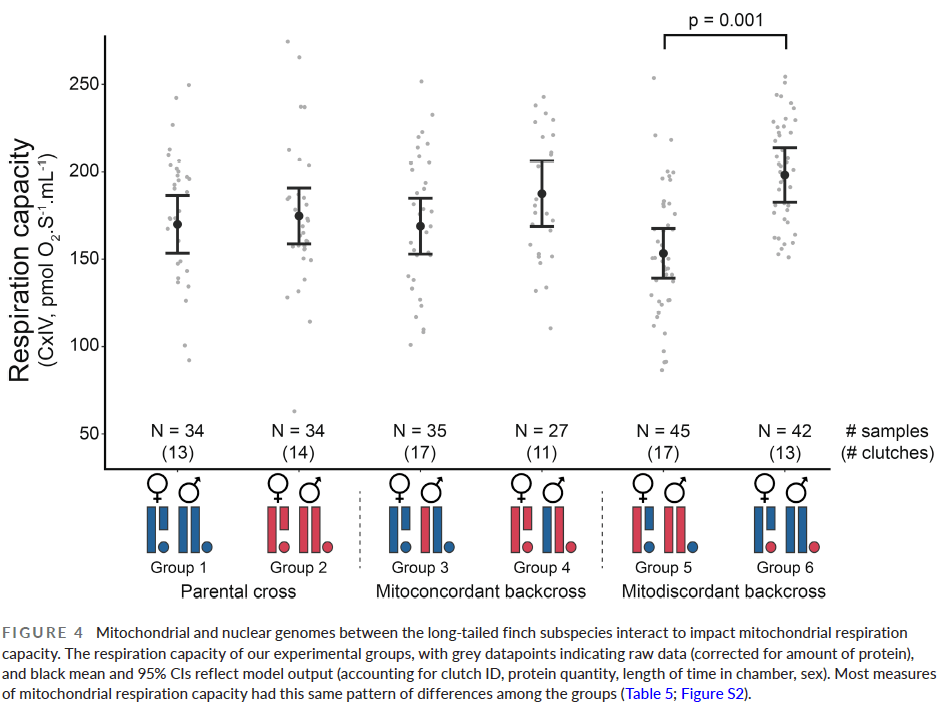
The difference between these two mitodiscordant backcrosses that we have demonstrated using a careful experiment in the laboratory is entirely consistent with the pattern of admixture in the wild. Group 5 here are individuals with acuticauda mtDNA in an otherwise hecki genome, while Group 6 individuals have hecki mtDNA in an acuticauda genome. The acuticauda mitotype therefore performs relatively poorly in the wrong background, compared to the hecki mitotype. The two subspecies are in contact in the wild, and we have found that 83% of those individuals that have mismatched mtDNA and nuclear genome in the wild have the hecki mitotype (i.e. as we have shown experimentally, that mitotype performs better when in the wrong background). Secondly, in the wild the contact zone between the subspecies is slightly complicated with the cline of mtDNA displaced about 55km to the west of the nuclear DNA cline. i.e. the hecki mtDNA is able to move further westwards, presumably because it performs better than the acuticauda mitotype in the zone of mixed genomes.

Figure 1b from McDiarmid et al (2024). This clinal analysis illustrates that the mtDNA cline is displaced further to the west than the nuclear DNA cline. i.e. the eastern mitotype (hecki) does better in a western acuticauda genomic background than vice versa.

In summary, whilst there is a relatively low level divergence between the mitochondrial DNA of the two subspecies that we have been studying in northern Australia, using experimental crosses in the laboratory, coupled with a sophisticated method for measuring the efficiency of cellular respiration, we have been able to show how functional differences can effect the introgression of genes from one from into another when species come together in secondary contact. Our findings from a bird add to recent work on other animals that support the idea that interactions between the mitochondrial and nuclear genomes can play important roles in the speciation process.

Epigenetics and the introduced populations of the house sparrow in Australia

Sparrowfig
The relationship between genetic differentiation between populations and epigenetic variation (Fig from Sheldon et al 2018)

In our most recent paper, published today in Royal Society Open Science (see article here), we examine the extent to which DNA methylation is related to genetic variation across different populations in the three introduction clusters of the house sparrow in Australia. We found no support for the idea that epigenetic variation might compensate for a lack of genetic diversity in introduced populations. However, we did find that patterns of epigenetic variation are highly variable across populations within each of these clusters, rather than having shared similarity across clusters (as in genetic variation). This study is still one of relatively few that has examined  the patterns of epigenetic variation across a number of populations and contributes to our growing understanding of the role of epigenetic variation in ecology and evolution.

It is particularly timely that the study is published today, the last day at Macquarie for both Ellie Sheldon who is departing to work on a field project in the Kimberley region, and Sam Andrew, who is heading to Finland to work with Craig Primmer on his Endeavour Fellowship.

Four PhD positions in our research group

We have four quite different PhD projects in the research group that have been advertised today. These are working across four species and some similar research questions. Three of the projects are based at Fowlers Gap which is an amazing field site in the arid zone near Broken Hill, where we have worked for the past 13 years. Work on the zebra finch in the wild, continues our ongoing into this species, where we have been the only lab in recent years trying to understand the ecology of the species in the wild (more details on that research here). The project with Stephan Leu is a new direction for us, into the behaviour and ecology of sheep in the rangeland. This project will use techniques that we have previously used in both birds and lizards, but use them in an applied context.

montage2

The project on the sleepy lizard is in collaboration with Martin Whiting’s group, also at Macquarie University.   We are hoping to recruit students onto all of these projects in 2017, in order to maximise the outcomes from current Australian Research Council funding to Griffith and Leu. Due to this funding the projects are well supported and will provide great research opportunities. We have a good history in the group of graduating our PhD students with a good number of peer-reviewed papers and a range of different skills that will enhance further career opportunities.

 Further Details

1: Adapting to a foreign climate: the reproductive ecology of the house sparrow in Australia

The house sparrow (Passer domesticus) was introduced into Australia in the 1860’s and has since become well established across a broad range of climates in both countries. This project will take advantage of this ‘experimental’ introduction to focus on behavioural and physiological adaptations to different climates through a field-based comparative approach. This research will complement our existing work on related questions in endemic Australian species and will provide insight into the capacity of avian species to adapt to changing climates. This project will involve periods of field-work in Broken Hill, Armidale and Hobart in Australia, along with a range of behavioural, molecular and physiological assays. The project will involve collaboration with other groups in Australia and the US.

 2: The challenge of growing in a hot climate (in the zebra finch)

In recent years we have characterised the very hot conditions in which zebra finches are raised (with nests often reaching temperatures over 40 degrees Celsius, as well as identifying adverse effects of these conditions on embryonic development, offspring growth, and adult sperm. This project is supported by an ARC funded project and will investigate the adaptations that this iconic and well-studied species has to deal with the extreme climate in which it lives. The project will take a variety of approaches including behavioural work, and assays of metabolism and physiology, and combine fieldwork and laboratory work. The project will be run in collaboration with Dr Christine Cooper (Curtin University, Western Australia), Prof. Pierre Deviche (Arizona State University, US), and Prof. Pat Monaghan (Glasgow, UK).

 3: Social structuring and life-history in free-ranging domestic sheep

In this project we will examine the importance of social structure and collective intelligence to life-history trade-offs and productivity in domestic sheep in the rangelands of Australia. The project will use tools from social network theory and spatial ecology to characterise individual and group behaviour and investigate their effect on individual quality and productivity (lambs and wool) in this challenging, but economically important part of Australia. The project will be based at Fowlers Gap (near Broken Hill in the arid zone) and require field work and well-developed analytical skills. This work will be run in collaboration with partners in the pastoral industry and be jointly supervised by Dr Stephan Leu (also at Macquarie University).

4: Parasite transmission dynamics in an Australian lizard

This project will investigate the relationship between host spatial and social behaviour and bacterial transmission. It combines social network theory, spatial ecology and wildlife epidemiology to determine how different bacterial strains are transmitted through the population and how individual behaviour and consequently population social structure changes as a function of infection status. The project combines the analysis of a very comprehensive (already collected) dataset with scope for the student to develop his/her own ideas and conduct fieldwork. The student should be interested in social networks and disease modelling and have strong analytical skills. This project will be jointly supervised by Dr Stephan Leu and A/Prof Martin Whiting (both at Macquarie University). We also have strong relationships with disease modelling colleagues in the US.

Application

The Department of Biological Sciences at Macquarie University is a vibrant environment which offers excellent support to postgraduate students. A Macquarie University Excellence in Research Scholarship has already been assigned to one of these projects, but there are other scholarship opportunities available to suitably competitive candidates. International candidates are welcome to apply for any of the projects listed above.

The 2014 MQRES full-time stipend rate is $26,682 pa tax exempt for 3 years (indexed annually). In addition to external grant support for projects, there is additional internal funding (up to $17,000) available to cover direct research expenses and conference travel.

Applicants should ideally have a research-based MSc in a related discipline (with a minimum 50% research component), and additional relevant research experience, qualifications, and details of awards or prizes. For projects 1, 2, and 4 an ability to work in remote and harsh conditions as well as experience in capturing and handling animals is desirable. A driving licence is required for all projects.

Applications should include 1) your CV, 2) a brief statement of your reasons for applying (max. 500 words) and the project you are applying to work on, 3) contact details of two academic referees, 4) your nationality (for scholarship eligibility purposes). Applications should be submitted electronically as a single PDF file.

Applications for these positions (and any initial enquiries) should be emailed by 7th April 2017 to: simon.griffith@mq.edu.au

Prof. Simon Griffith, Dept. of Biological Sciences, Macquarie University, Sydney, NSW 2109, Australia

PDF of advert

Lack of clear genetic structuring in wild populations of the endangered Gouldian finch

Peri’s paper characterising the population genetics of the Gouldian finch in the wild was published last week in the open access PLosOne. This paper focuses on birds sampled from across the range of the Gouldian finch including samples from Mornington and Wyndham in the Kimberley, Western Australia; a number of sites in the Northern Territory, and Chidna in Queensland. DNA extracted from blood samples taken from the wild birds was analysed using three molecular approaches and indicates that there is no clear genetic structuring across the sampled areas. This is consistent with a view that Gouldians are quite mobile, and individuals may be found across a wide range. An implication of this molecular work is that the species may be more difficult to reliably census than species which have a higher level of genetic structuring, and are more restricted to particular areas or sites.

gouldiangeneticsfiga
Network connecting mitochondrial control region haplotypes from the different sampling localities (Figures from Bolton et al 2016, in PLosONE)

The rationale for undertaking this work was to help inform management of this species, and this work was part of our submission to the committee responsible for the Federal Environmental Protection and Biodiversity Conservation Act, who on the 7th December announced their decision to retain the status of the Gouldian finch as ‘endangered’ which is a great outcome and maintains a good degree of protection for the species and its habitat.

The full paper is open access and can be found here.

Sam arrives in Norway to work on the SNP data from the Australian sparrows

SamNorwayASam is currently in Norway working with the house sparrow genetics group in Trondheim to look at SNP data from the Australian sparrows. During his trip, he is being hosted by Glenn-Peter Saetre in Oslo and Henrik Jensen at NTNU in Trondheim. This molecular work should provide a high level of coverage for population genetics and history and hopefully also for looking at selection across the different Australian climates.

Peri’s second paper!

Peri’s second paper was published today in Molecular Ecology. It was a follow up to her first paper which attracted useful discussion by Anders Forsman (Lund, Sweden). The new paper clarifies our thoughts on why polymorphic species might be vulnerable because of the negative interactions between different morphs. Conceptually it builds from our work on the Gouldian finch and long-tailed finch.

The paper can be found here: http://onlinelibrary.wiley.com/doi/10.1111/mec.13632/abstract?campaign=wolearlyview