
Sometimes it takes a while to get studies out….. Finally this week our paper describing the variation in sperm and testosterone over the breeding cycle was published in Hormones and Behaviour. The study was initiated back in 2011 through discussions between Kate Buchanan, Melissah Rowe and myself. The study was supported by funds from the Australian Research Council awarded in 2012 and then conducted by Lori Hurley as part of her PhD. Two postdocs, Ondi Crino and Riccardo Ton have also made significant contributions to the study, by dealing with a complicated dataset and writing the manuscript.
The study characterises variation in the level of testosterone circulating in the blood of males across different stages of the breeding cycle (nesting, egg-laying period, incubation, and nestling rearing), and how those levels covary with the morphology and motility of sperm. This contributes useful knowledge to our understanding of how birds that breed opportunistically (whenever conditions are suitable) manage trade-offs between different physiological traits. Whilst many birds have a very seasonal pattern of breeding, with a flush of hormones and production of sperm arriving with the lengthening days of spring, zebra finches remain reproductively active throughout the year. In the desert, conditions can be suitable for breeding throughout the whole year, depending on when the rain falls.
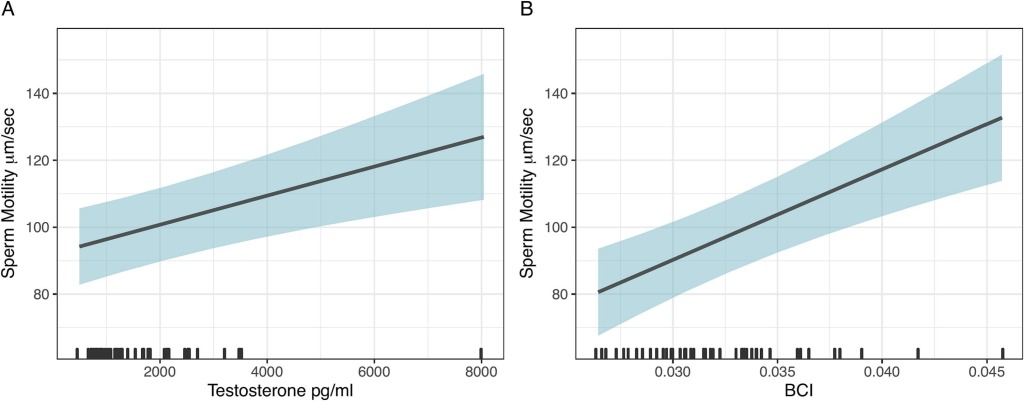
We showed that testosterone levels were fairly low across different breeding stages, but did significantly increase at the time when a males’ partner is about to become fertile again (as one set of offspring are about to fledge. The higher level of testosterone makes sense, because we demonstrated that higher testosterone is related to the swimming performance of sperm.

 Griffith Ecology Lab